


Mathematics at the heart of major challenges
Mathematics at the heart of major challenges
The major challenges facing our planet require cross-disciplinary perspectives and ongoing dialogue between science and society.
Scientific challenges
for society and the environment
Scientific challenges for society and the environment
From climate change and species extinction to urbanisation, resource consumption, pollution and disease, the environmental consequences of human interaction with the Earth raise major societal challenges. The urgency of the situation calls for a large-scale, interdisciplinary scientific strategy.
Transversal questions
Transversal questions
How can decision-making best be informed to ensure sustainable resource management? What forms of urban organisation are most environmentally sustainable? How can panic be taken into account when modelling crowd behaviour? How can effective evacuation procedures be developed for natural disasters or terrorist attacks? How should extreme events be taken into account? How does climate change affect the migration patterns of birds? What are the uncertainties in projections derived from climate models?

Mathematics in synergy
with other sciences
Les mathéma-tiques en synergie avec les autres sciences
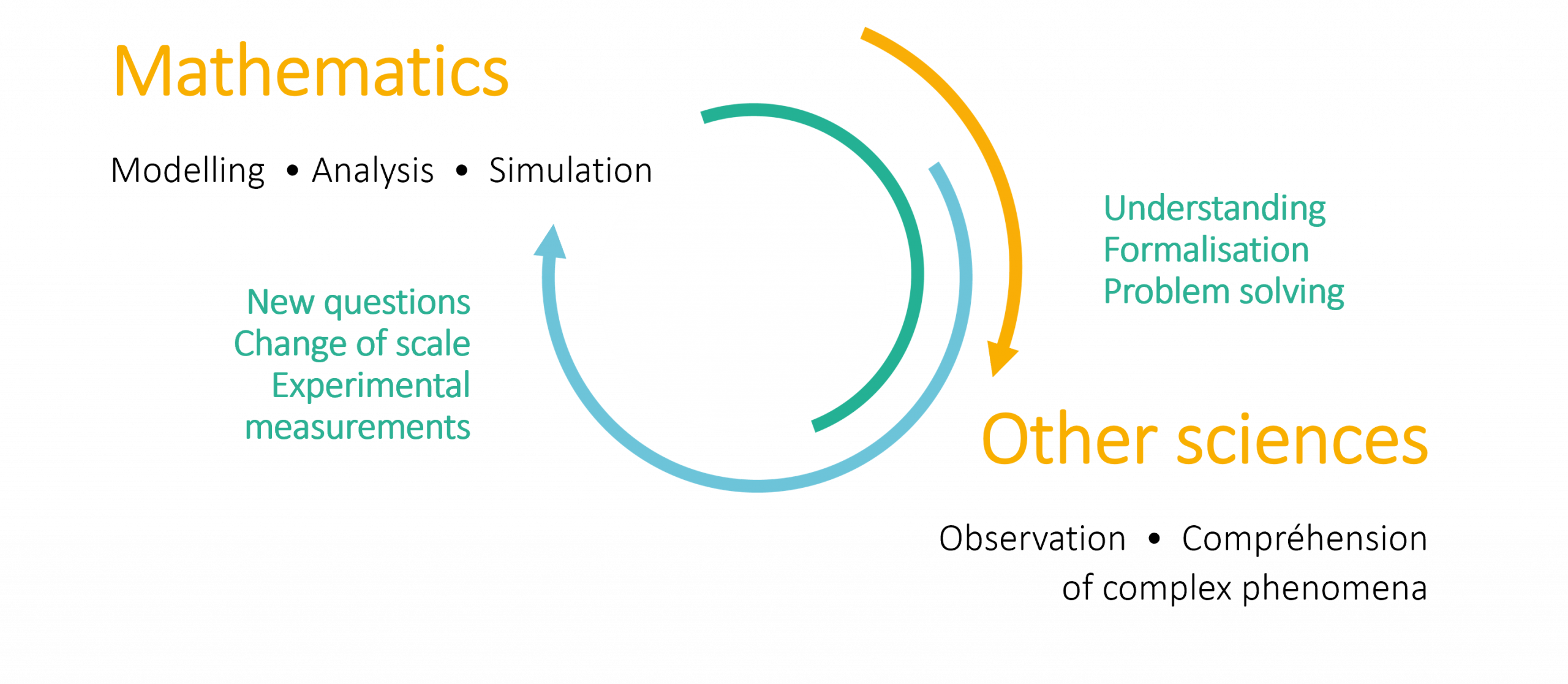
Mathematics plays an important role in other disciplines, providing theoretical and numerical insights through modelling, analysis and simulation. It allows us to understand, describe and tackle complex problems in fields such as biology, chemistry, physics, ecology, economics, computer science, geography and demography. In turn, the challenges that arise in these areas help drive the development of new mathematical theories.

After years, I have deeply regretted that I did not proceed far enough at least to understand something of the great leading principles of mathematics: for men thus endowed seem to have an extra-sense.
Darwin
Autobiography, 1887